跳到内容

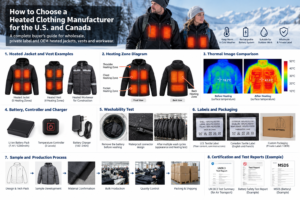
A physical sample check of the inner pocket, USB connector and garment instructions.
When a supplier sends a test report, look for the model number before you look at the laboratory logo.
For a heated jacket order, the garment, battery, charging equipment and controller should all be identifiable. The useful question is whether each document relates to the configuration you intend to buy and the requirement you need to address.
A practical review of heated apparel compliance documents starts with that connection. Establish the product and market, identify the relevant evidence, then resolve any gaps before treating the paperwork as complete.
Start with the product and destination market
Give the supplier and your compliance reviewer a defined product brief. Include the destination country, intended wearer, proposed claims, garment model and supplied accessories. Identify any wireless functions or protective-use claims that need assessment.
Be precise about the retail package. A jacket supplied alone, a jacket with a battery, and a kit that also includes a mains charger need their supplied items clearly recorded.
Ask the responsible importer or qualified compliance reviewer to identify the applicable requirements for that configuration. This should guide the document request.
Official resources can help begin that review:
| Market | Official starting point | Question to take into the review |
|---|---|---|
| European Union | Your Europe’s CE-marking guidance | Which rules apply to the finished product and supplied components, including whether CE-marking legislation applies? |
| United States | CPSC’s Regulatory Robot | Which CPSC consumer-product safety requirements should be reviewed for this product? |
| Japan | METI’s product-safety and PSE resources | Do the proposed battery, charging equipment or other items fall within the Electrical Appliances and Materials Safety Act’s designated categories? |
| South Africa | NRCS guidance on imports and approvals | Are any supplied items covered by applicable compulsory specifications and the associated approval process? |
These are starting points, not complete market-access checklists. Record any additional requirements identified for the product, sales channel and intended use.
Map the documents to the actual components
Create a short component list before reviewing the files. Use model references from the quotation, sample labels and technical specifications.
| Item in the proposed order | Identity to record | What the document review should establish |
|---|---|---|
| Finished heated garment | Style, version, materials and heating configuration | Which evidence addresses the finished product as configured |
| Battery or power bank | Manufacturer, model, electrical ratings and battery configuration | Whether the records relate to the supplied battery or relevant battery-powered product |
| Charging equipment | Model, input/output ratings and supplied plug or cord arrangement | Whether the equipment in the quotation matches the documented version |
| Controller | Model or revision, operating arrangement and connections | Whether the relevant records cover the controller and its use in the proposed assembly |
| Heating elements and wiring | Part references, layout and assembly specification | How component information relates to the finished garment’s evaluation |
This is a mapping exercise. It does not mean that every row requires its own separate certificate.
For example, a document may cover a defined group of models or a complete assembly. Ask where that coverage is stated and how the ordered version fits within it.
If a battery test report names the cell manufacturer, find out how that information relates to the assembled battery being supplied. Keep cell-level records and evidence for the finished battery configuration clearly identified.
Recognize what each document is meant to do
A folder can contain several different kinds of evidence. Read the document title and scope before deciding which question it answers.
| Document type | Main review question |
|---|---|
| Test report | Which sample was evaluated, against which methods or standards, and with what results? |
| Certification document | Which certification scheme, products and conditions does it cover, and what is its current status? |
| EU declaration of conformity, where applicable | Which responsible manufacturer and product are identified, and which applicable EU requirements are declared? |
| UN 38.3 test summary | Can the battery or product model be traced to the relevant battery transport-test information? |
| Safety data sheet, or SDS, if supplied | What safety and handling information does it provide, and does it answer the document request being made? |
Treat the document’s stated scope as the starting point. A battery record should not be filed as proof of an unrelated garment claim simply because both belong to the same order.
How to read a heated jacket test report
Request a legible, complete report or agree on a suitable review arrangement for confidential material. A cover page may identify the file without showing the model coverage, test conditions or results you need.
Check these details together:
- Document identity: report number, issue date, revision and referenced annexes.
- Product identity: tested model, sample description, photographs and relevant electrical ratings.
- Companies named: applicant, manufacturer and other parties, with their roles explained.
- Test basis: the standards or methods used, including editions where stated.
- Test scope and results: what was assessed, any limitations, and which results address your identified requirements.
- Connection to the order: the exact quoted configuration and any differences from the tested sample.
The company named in a component report may differ from the company selling you the jacket. Ask for the relationship and product mapping to be explained. A different company name is a point to resolve, not a reason to assume that the document is false.
Model differences need the same care. If the quotation uses a different suffix, brand name or product code, request a documented explanation of the relationship. Where coverage is uncertain, have the issuing body or appropriate reviewer clarify it.
Verify the laboratory or certification body
Use independently located official contact details or the issuer’s verification service, where available. Provide the report or certificate number and the model under review. The issuer may need the applicant’s authorization before releasing details.
When laboratory accreditation is claimed, verify both its status and its relevant scope. ILAC explains that accreditation bodies maintain laboratory directories and scopes. Check whether the relevant testing activity is included; the presence of an accreditation logo alone does not answer that question.
Accreditation status and the authenticity of a particular report are separate checks. Record the result of each inquiry and any points still unresolved.
Review the lithium battery test summary separately
For a proposed lithium-battery configuration, request the applicable UN 38.3 test summary and trace its model identification to the battery or battery-powered product being supplied.
PHMSA’s test-summary guide lists the standardized information. Review the manufacturer and laboratory details, report reference and date, battery description, tests and results, and referenced manual edition against the guide’s full list.
PHMSA’s U.S. guidance allows a single test-summary document to cover multiple batteries, manufacturers or products when all required information is included. Locate the supplied model and its corresponding test report number and date.
A general statement in an SDS saying that the battery meets UN 38.3 does not replace the manufacturer or distributor’s obligation to make the required summary information available under the U.S. rules discussed in PHMSA’s interpretation.
Keep this transport-related evidence separate from the review of the garment’s other market requirements.
Understand an EU declaration of conformity in context
For products covered by applicable CE-marking legislation, the review involves the relevant conformity-assessment process, technical documentation and an EU declaration of conformity.
The EU’s official guidance explains that there is no central EU authority issuing a universal certificate permitting CE marking. It also warns about voluntary certificates that do not establish the required conformity.
For the product under review, identify the responsible manufacturer, exact product and applicable legislation. Ask which evidence supports the declaration and whether any required third-party assessment has been addressed.
Keep the garment, battery and charging equipment identifiable throughout that review. Do not assume that a document for one item settles the assessment of the entire retail package.
Keep the evidence aligned when the order changes
Document review should continue through sample approval and any later changes.
If the battery model, controller, heating layout, garment material or charger changes, send the change to the responsible reviewer. Ask whether the existing evidence still covers the revised configuration or whether further evaluation is needed.
For example, suppose the approved sample uses Battery A, but the bulk quotation is later revised to Battery B. Record that substitution and review the supporting information before carrying forward the earlier approval.
Keep an order record that connects:
- The approved garment and component versions.
- The document references used for each identified requirement.
- The reviewer’s decision and any limitations.
- Open questions, who will answer them and the planned next step.
- Any approved changes made after the initial review.
Preserve the original documents and keep your mapping notes alongside them. This makes later questions easier to investigate without relying on someone’s memory of an email exchange.
Frequently asked questions
Does a UN 38.3 test summary need a new date every year?
In its guidance on the U.S. Hazardous Materials Regulations, PHMSA states that a lithium battery test summary does not expire. New or revised information is needed when a design change requires retesting. Check that the information still corresponds to the product supplied. Other document types may have different validity or review conditions.
What if a supplier will not share the full report?
Ask which information is being withheld and whether your nominated reviewer can inspect the complete document through an agreed confidential arrangement. Keep the model coverage, report identity and relevant results verifiable. If the available information is insufficient, leave the requirement open rather than recording it as resolved.
Discuss your heated apparel documentation requirements with Everlanda
Send the garment reference, proposed battery and charging package, destination market and document requirements already identified by your reviewer.
If you are considering our M61 and M62 heated fleece jackets, specify the selected model and configuration. Tell us which records you need to review so we can check their availability and identify any information still to be confirmed.
Use our heated jacket RFQ checklist to organize the brief. For garment and power-source details, see 5V vs 7.4V vs 12V heated jackets.
Send your brief to Everlanda so we can review your requirements and confirm whether we can support the project.
Discuss Your Heated Apparel Requirements