跳到内容

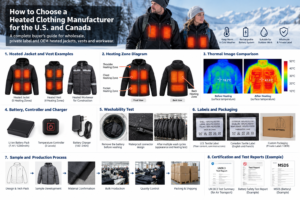
M61/M62 product illustration. Orange areas indicate heating-zone locations.
Imagine sending the same jacket photo to three suppliers and receiving three very different prices.
One quote includes a battery. Another covers the garment only. The third uses a different fabric and assumes you will supply the packaging. Before you can judge the prices, you have another job to do: work out what each company is actually offering.
Choosing a heated jacket supplier starts with making those details visible.
For brands, importers and distributors sourcing heated jackets or vests, our recommendation is to begin with a short product brief, check who is responsible for each part of the order, and ask every supplier to quote against the same requirements. This heated jacket RFQ checklist will help you prepare that conversation.
Start with the product you want to sell
A useful first inquiry explains who will wear the garment, where you plan to sell it and what you need to change.
For example, you might want an existing vest with your labels, an established jacket with a different fit, or a new design developed from your technical pack. Describe that scope before asking for a price.
If you are starting from an existing product, include its model reference and a link, such as Everlanda’s M61 and M62 heated fleece jackets. List the changes you want beside that reference.
For private label heated jackets, list the branding details that matter: logo position, neck label, care label, instructions, hangtags and packaging. Then identify any changes to the garment or heating system separately. Having your own brand on the product does not, by itself, explain how much development is involved.
For an OEM heated jacket project, send the design information you already have. Reference photos, measurements, a fabric brief and a list of required features can help start the discussion. If part of the specification is undecided, mark it as open and ask the supplier to propose options.
Be clear about the battery and power configuration, too. Do you want the garment, battery and charging accessories quoted together? Or do you intend to source some of those items separately?
If you are also looking for a heated vest supplier, tell them whether the jacket and vest need to use the same battery system. Ask for that compatibility to be confirmed for the proposed models.
Build an RFQ a supplier can actually quote
An RFQ is a request for quotation. Its job is to make your requirements clear enough for suppliers to price a comparable product.
You do not need to decide every detail before making contact. You do need to distinguish firm requirements from items where you want advice.
Use this checklist when preparing your inquiry:
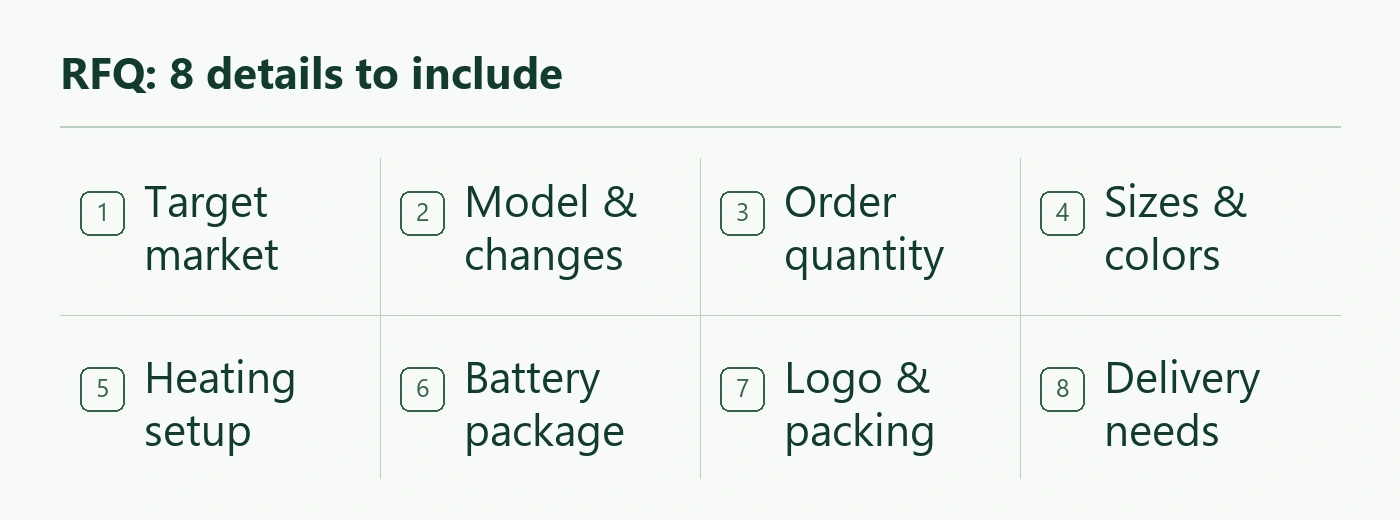
| RFQ item | Information to include |
|---|---|
| Target market and customer | Country of sale, sales channel and intended wearer |
| Product reference | Jacket or vest, style or model reference, photos, drawings or an existing product you want to adapt |
| Order quantity | Estimated quantity by style and color, plus the proposed size range |
| Garment requirements | Fit, fabric, lining, insulation, pockets and other details that matter to your product |
| Heating system | Required heating areas or controls, with open decisions clearly identified |
| Power configuration | Required voltage, connector type and battery model, if already specified. If undecided, ask the supplier to propose a matched garment, controller, battery and charging configuration and identify the proposed models |
| Battery and accessories | Whether to include batteries, charging cables, wall chargers and spare units |
| Supporting documents | Any documentation requirements already identified for your project; ask the supplier to identify the exact garment, battery or controller model covered by each file and flag any mismatch with the quoted configuration |
| Branding | Preferred logo method, artwork, placement, labels and instructions |
| Packaging | Individual packaging, barcodes and carton requirements |
| Delivery location | Destination country, city, postal code and warehouse address or named port, as applicable; state the requested delivery basis or ask the supplier to identify the basis and named place used |
| Schedule | Required warehouse arrival date and any sample approval deadline |
| Quotation response | Currency, delivery basis, inclusions, exclusions, sample charges, any sample-fee credit conditions and applicable order minimums |
If you have a target purchase price, explain what you expect it to cover. A jacket-only target and a complete retail-package target give the supplier different problems to solve.
Include your artwork when it is ready. If you are still developing the branding, identify what can be quoted now and what will need confirmation later.
Find out who is responsible for your order
If you are looking for a heated apparel private label manufacturer, start by confirming the company’s role in your order. Is it the manufacturer, a trading company or a sourcing partner? Ask which work it handles directly and which work is handled by other businesses.
That gives you a more useful picture of the supply arrangement than a factory photo alone.
A practical question is:
If there is a problem involving both the garment and the heating system, who will investigate it and coordinate the response?
Ask each heated apparel supplier to explain its responsibilities in writing. You should know who confirms the specification, who coordinates production, who arranges inspection and who handles an after-sales issue.
Use these questions to guide your initial checks:
| What to check | What to ask for | What you need to understand |
|---|---|---|
| Company identity | Registered company details, business address and the entity named on the quotation | Which business you would be ordering from |
| Production arrangement | An explanation of where the garment and heating components are made and how they are assembled | Which operations are handled directly or through partners |
| Relevant product experience | A sample or product information for a comparable style | How closely the available product matches your brief |
| Order communication | A named contact and a process for confirming changes | Who keeps your requirements and approvals aligned |
| Quality and inspection | The proposed checks, available records and inspection arrangements | What can be reviewed before shipment |
| After-sales handling | Written procedures for reporting a problem and agreeing a remedy | Who takes responsibility after delivery |
Where practical, request a live video walkthrough or an inspection of the relevant production location. Ask the supplier to explain what you are seeing and how it relates to the proposed order.
Record unanswered questions. An unresolved point should remain visible when you compare suppliers.
Ask for evidence that matches the proposed product
Keep the discussion tied to a style reference and a defined configuration.
If the supplier sends a sample, ask which fabric, battery, controller and accessories it represents. If any component differs from the quotation, request an explanation before treating the sample as the order reference.
The same approach applies to heated apparel compliance documents. Ask which model or component each document covers, and whether that matches the configuration being offered. A collection of files is much easier to review when each one is connected to a specific item.
For product claims such as runtime or washability, request the relevant records and conditions. At this stage, the aim is to establish what evidence is available and what still needs verification.
This also gives you a way to assess communication. After you ask a specific question, check whether the reply answers it and identifies anything that remains uncertain.
Compare the quotation line by line
Once the replies arrive, check the product configuration before ranking the prices.
Also review the assumptions behind each offer:
- Does the price apply to your proposed color and size mix?
- Are sample charges and development charges listed separately?
- Which accessories and packaging items are included?
- Which garment, controller and battery models does the price cover?
- What delivery basis and named place are being quoted, and which delivery charges are included or excluded?
- Which approvals are required before the quoted production period begins?
If a supplier proposes an alternative, keep it as a separate option. You can then assess the saving or added cost alongside the actual specification change.
Leave a column for questions still awaiting answers. That small step helps prevent an assumption from becoming an accidental agreement.
Use the sample stage to confirm the next decision
Before paying for a sample, agree on what it needs to demonstrate. Our guide to MOQ, samples and lead times for custom heated jackets covers the quantity and scheduling questions to settle alongside sample approval.
You might be reviewing the fit, the finish, the battery-pocket position or a proposed branding method. Write down the purpose and ask which parts of the sample will match the intended production version.
During development, keep a clear record of revisions. A photo, style reference and dated comment sheet can make it easier for both sides to identify the version under discussion.
If the sample meets your requirements, confirm the specification, remaining approvals and next commercial step. If it needs changes, list them clearly and ask how they affect the quotation and schedule.
A heated jacket supplier should be able to explain what is agreed, what is still open and what information is needed from you next.
A first inquiry you can adapt
Subject: Heated Jacket RFQ: [Style / Estimated Quantity / Target Market]
Hello,
We are sourcing heated jackets and vests for our brand in [target market].
Our initial requirement is [estimated quantity] across [styles, colors and size range]. We are looking for [an existing style with our branding / changes to an existing design / development from our design].
Product reference or attached brief: [model / product link / file name and revision].
Power requirements, if already specified: [voltage], [connector type] and [battery model]. If these are not yet decided, please propose a matched garment, controller, battery and charging configuration and identify the proposed models.
Battery and charging accessories: [include in the quotation / quote as separate options / we will supply them].
Please confirm whether you can support the attached brief and provide:
- Relevant product options and sample details.
- An itemized quotation identifying the garment, battery, charging accessories, branding and packaging, with the quoted models, currency, inclusions and exclusions.
- Applicable minimum quantities by style and color.
- Sample charges, any credit toward a bulk order and its conditions, and the proposed approval process.
- The production lead time and the conditions for starting it.
- Available product documents, with the exact garment, battery or controller model covered by each file and any differences from the quoted configuration.
- Proposed inspection arrangements, warranty coverage and after-sales terms.
Delivery location: [country, city, postal code and warehouse address or named port].
Requested delivery basis: [if known; otherwise, please state the basis and named place used in your quotation]. Please identify included and excluded delivery charges.
Our required warehouse arrival date is [date].
For any undecided specifications, please propose options and explain their effect on the quotation.
Kind regards,
[Name / Company]
Frequently asked questions
Can a trading company be a suitable heated apparel supplier?
Assess how the company coordinates production, confirms specifications, arranges inspection and handles problems. Ask it to identify the responsible parties in writing before you commit to an order.
What if I do not have a technical pack?
Send reference images, the intended wearer, target market, estimated quantity, size range and requested changes. State whether batteries should be included and mark open decisions for the supplier to advise on.
Discuss your heated apparel brief with Everlanda
For orders that add your logo or replace the main label, the MOQ is 100 pieces in one color. Mixed orders are reviewed case by case and must be confirmed in the quotation. Changes to fabric, fit or the heating system require a separate review of minimum quantities and commercial terms. Send us your preferred style and quantity breakdown so we can review the proposed order.
For orders of fewer than 200 pieces, our normal production lead time is 10–15 working days. The starting point for that period and the shipping schedule need to be confirmed for your order.
We offer custom samples, and sample fees can be credited toward a bulk order. Ask us to confirm the applicable credit conditions when requesting a sample. Logo options include heat transfer printing, embroidery and silicone labels.
Our heating elements and batteries carry a one-year warranty. This coverage applies to those components, not to the garment as a whole.
Send your brief to Everlanda so we can review your requirements and confirm whether we can support the project.