跳到内容

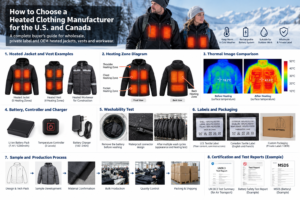
M61/M62 back-view product illustration. Orange areas mark heating zones.
You have a jacket style in mind, a logo ready and a first order to plan. Before committing, you need three answers: how many pieces you can order, what the sample will show you, and when the finished jackets could reach your warehouse.
Those questions belong in the same conversation. A minimum quantity needs a defined product behind it. A sample needs a clear purpose. And a production estimate needs a starting point before you can use it to plan a delivery.
For brands sourcing custom heated jackets or vests, the details below will help turn an initial inquiry into a workable first-order plan.
For your first brief, use our heated jacket RFQ checklist to organize the details you send to suppliers.
Clarify what the 100-piece MOQ covers
MOQ means minimum order quantity. For orders that add your logo or replace the main label, the MOQ is 100 pieces in one color. Mixed orders are reviewed case by case and must be confirmed in the quotation.
When you request a quotation, show how you want to divide that quantity. Include the selected style, proposed colors and units in each size. Ask the supplier to confirm that the quoted minimum applies to that exact combination.
If you propose splitting a logo or main-label order across two colors, do not assume that a combined total meets the single-color minimum. Give the quantity for each color and request a quotation for the proposed mix. If you also want jackets and vests, list them separately so the supplier can review the quantity for each product.
Adding a logo or replacing the main label is different from changing the fabric, fit or heating layout. For those development changes, request a separate review of feasibility, minimum quantities, sample work and schedule.
You can use an existing product, such as Everlanda’s M61 and M62 heated fleece jackets, as a reference. Mark what you want to keep and what you want to change before discussing the minimum.
Define your customization before confirming the minimum
The most useful follow-up to an MOQ is: “What does this quantity cover?”
Break your requested changes into three groups. That makes it easier to see which decisions may require additional sourcing, sample work or a revised quotation.
Fabric, color and fit
Tell the supplier whether you want the proposed fabric and color or a different material. If you have a fabric swatch, color reference or measurement chart, include it.
The question to resolve is whether the selected material is already available or needs a separate order. Ask whether a material or color requirement has its own minimum, and how that would affect your proposed garment quantity.
Treat fit changes separately. If you want a longer body, more room through the chest or a different sleeve shape, record those changes with measurements. A request for “a more comfortable fit” leaves too much for both sides to interpret.
Heating and power configuration
For an OEM heated jacket project, identify whether you want to keep the proposed heating and power configuration or request a change.
A different battery pocket, controller position or heating layout should be listed as a development question. Ask what needs to be reviewed on a sample and whether the change affects the quoted quantity, cost or schedule.
Also state whether you want batteries and charging accessories supplied with the garments. Keep those items visible in the quotation so the sample package and the intended order can be compared.
Logo, labels and packaging
For private label heated jackets, specify the logo method, finished dimensions and placement. Everlanda’s logo options include heat transfer printing, embroidery and silicone labels.
A logo file alone does not show how you expect the finished garment to look. Add a placement reference and identify any labels, hangtags, instructions or packaging you need.
If you are considering more than one branding method, ask which options can be sampled on the selected fabric and what each would cost. You can also review the branding and sample approval information when preparing your brief.
Decide what the custom sample must show
Before ordering a sample, decide what you need to learn from it.
You might need to assess fit, review the feel of the fabric, choose a logo method or check the proposed garment and power package together. Tell the supplier which decisions the sample must support.
Everlanda offers custom samples. When requesting one, agree on the sample specification and ask which details will match the intended bulk order.
A sample can answer some questions while leaving others open. For example, you may approve the fit while still waiting to see the final logo. Record those as separate decisions.
Avoid replying only “sample approved” when something still needs changing. A clearer response is: “Fit approved; logo position needs revision.” Attach a marked photo or measurement note and identify the sample version.
Confirm sample charges and fee-credit conditions
Everlanda’s sample fees can be credited toward a bulk order. The applicable credit conditions should be confirmed when you request the sample.
Ask for the amount that can be credited, the order conditions that apply and how the credit will appear on the bulk-order quotation or invoice. These are questions to resolve for your project; they should not be assumed from the phrase “sample fee credit.”
If the sample needs another revision, request the cost and timing for that revision before proceeding. Keep the sample charge, revision charges and any agreed credit clear in the written quotation.
Understand the production lead-time estimate
For orders of fewer than 200 pieces, Everlanda’s normal production lead time is 10–15 working days.
The starting point for that period and the shipping time still need to be confirmed for the order. Use the production estimate as one part of your plan, rather than treating it as a warehouse arrival date.
Ask what event starts the quoted production period and what the end of that period represents. Does the schedule depend on sample approval, material confirmation, payment or another agreed step? Have the supplier identify the actual conditions.
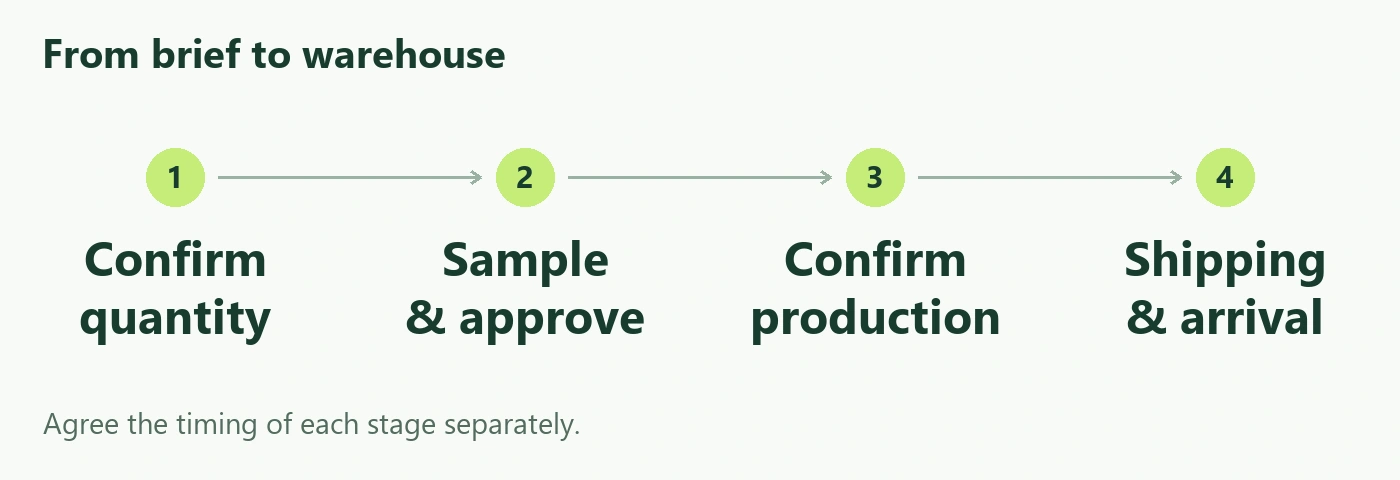
Keep the stages visible:
| Stage | What to confirm |
|---|---|
| Sample specification and agreement | Define what the sample must demonstrate, which details will match the intended bulk order, and the sample cost and schedule for the specific design. |
| Sample review and revisions | Record approved and open details, identify the sample version, and agree on any revision cost and timing before proceeding. |
| Bulk production | Confirm the actual conditions that start production and what the end of the period represents. For orders of fewer than 200 pieces, the normal production estimate is 10–15 working days; confirm the starting point for the order. |
| Shipping and warehouse arrival | Confirm shipping time and destination against the required warehouse arrival date. Keep shipping separate from the production estimate. |
Do not use the 10–15-working-day production estimate as a sample lead time. Request a sample schedule for the specific design.
The quantity limit matters, too. An order of exactly 200 pieces is outside the stated “fewer than 200 pieces” range. For 200 pieces or more, request a schedule for that order.
Plan backward from your warehouse arrival date
Give the supplier your required warehouse arrival date and destination, along with the quantity and proposed customization.
That is more useful than simply asking for the “fastest delivery.” It allows the discussion to cover sample review, production and shipping against the date that matters to your business.
If you have a launch, customer delivery or seasonal sales window, identify that deadline at the start. Ask the supplier to show the proposed milestones and any decisions that still prevent the schedule from being confirmed.
Leave space in the plan for reviewing the sample and replying with consolidated comments. If several people need to approve the garment, artwork or packaging, agree who will send the final decision.
For a first trial order, choose the sample questions that matter most to the product you intend to sell. You may need to settle fit and logo appearance first, while discussing optional packaging separately. Ask the supplier which decisions must be closed before production can begin.
Keep one record of the approved order
Once the sample is acceptable, bring the approved details into one record.
Include the style reference, measurements, material, color, logo artwork, heating configuration and supplied accessories. Identify the sample or revision that represents each approved detail, together with the agreed quantity breakdown.
This gives both sides a reference when a question comes up later. If the approved photo shows one logo position and a newer artwork file shows another, resolve the difference before treating the order as ready.
When you request a change after approval, ask which parts of the quotation and schedule need to be updated. A small-looking change should still be recorded clearly so the correct version reaches production.
Frequently asked questions
Can I request a sample before confirming the bulk quantity?
You can request a custom sample while planning the order. Share your estimated quantity and explain that it is provisional. Ask for the sample cost and lead time, and confirm the conditions for any later sample-fee credit. The sample request and the bulk-order commitment should remain clear in the quotation.
Does garment sample approval also cover labels and packaging?
Specify what your approval covers. If you have only reviewed the garment, ask to review the labels, instructions and packaging artwork separately. Keep unfinished packaging decisions visible when agreeing the production schedule.
Discuss your sample and trial order with Everlanda
Send us the style you are considering, your estimated quantity and the changes you want to make. Include your preferred logo method, delivery destination and required arrival date.
If you are still deciding between options, tell us which details are fixed and where you would like suggestions. We can review your requirements and confirm whether we can support the project.