跳到内容
Choosing a heated clothing manufacturer is not the same as sourcing an ordinary jacket or vest.
A heated garment combines apparel, heating elements, wiring, a controller, a battery, a charger, labels, user instructions and after-sales support. A weakness in any one of these components can lead to inconsistent heating, short battery life, high return rates or shipping delays.
For U.S. and Canadian buyers, the right supplier should be able to explain the complete product system—not only the fabric, color and logo.
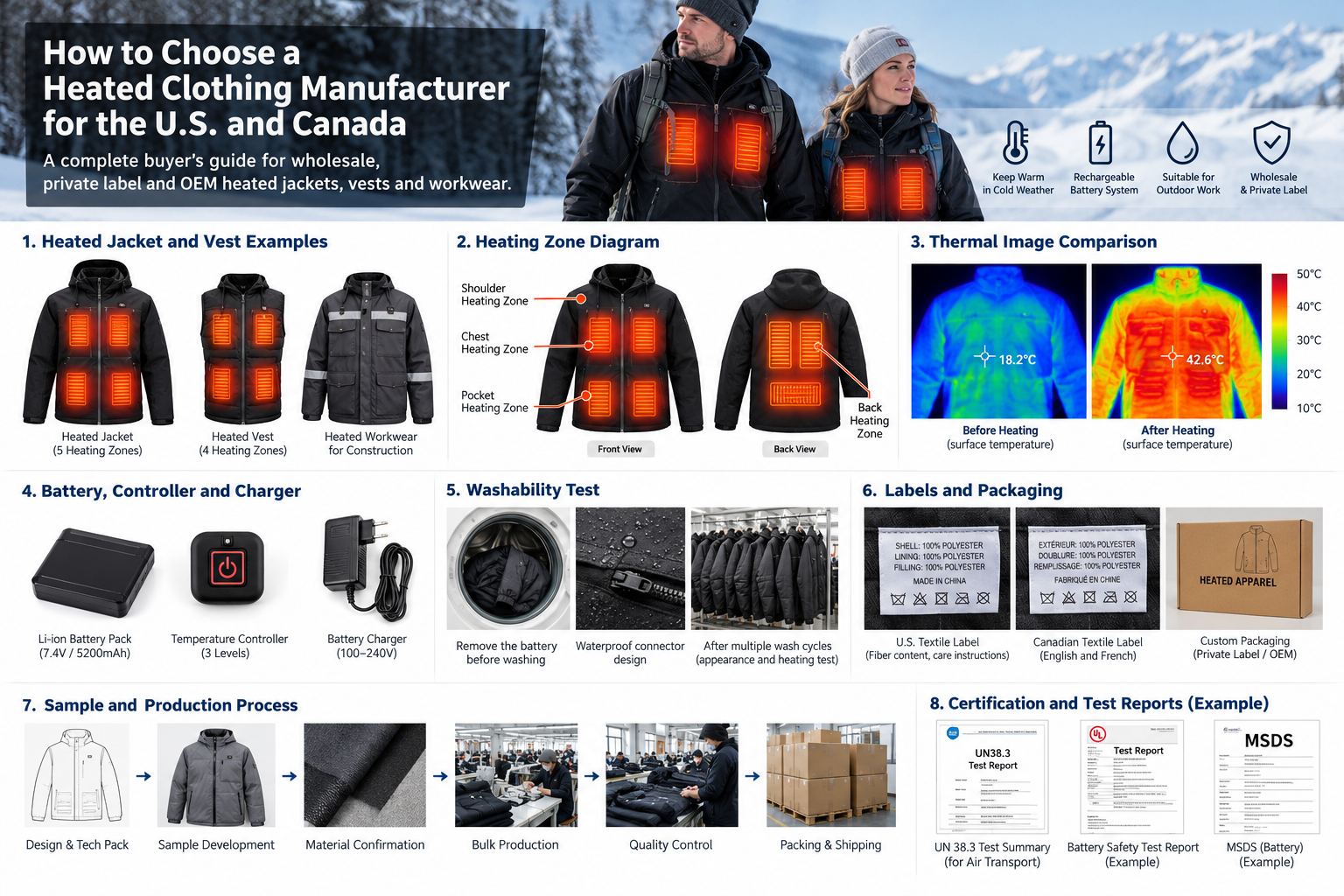
View the full-size heated apparel sourcing illustration. Product configurations, thermal readings, labels and report images are illustrative examples, not test results or certifications for a specific product.
Quick Answer
A qualified heated clothing supplier should provide clear heating-system specifications, traceable battery documentation, market-appropriate labels, a structured sample process, wash and durability testing, production quality controls and an after-sales plan.
Before placing a bulk order, evaluate the supplier using the following twelve questions.
1. Are You Buying Wholesale, Private Label, OEM or ODM?
These sourcing models are often confused, but they involve different levels of cost, control and development time.
| Sourcing model | What the buyer receives | Best for |
|---|---|---|
| Wholesale | Existing branded or unbranded products | Retailers needing fast stock |
| White label | Existing product with limited branding changes | Small brands testing demand |
| Private label | Existing product platform with custom labels, colors or packaging | Brands seeking a faster launch |
| OEM | Product manufactured to the buyer’s specifications | Established brands with detailed requirements |
| ODM | Supplier develops or modifies the product system | Buyers needing design and engineering support |
A buyer who only needs a logo and custom packaging should not pay for a full ODM program. Conversely, a brand that wants new heating-zone placement, a different voltage platform or custom controller logic should not assume a basic private-label product can support those changes.
Clarify the sourcing model before requesting a quotation.
2. Who Controls the Garment, Heating System and Battery?
Some suppliers manufacture the garment but purchase the heating system and battery from separate vendors. Others coordinate the complete project through specialized production partners.
Neither model is automatically better. What matters is accountability.
Ask the supplier:
- Who develops the garment pattern?
- Who produces the heating elements?
- Who assembles the controller and wiring?
- Who supplies the battery cells and battery-management system?
- Who performs the final system test?
- Who is responsible when one component fails?
The supplier should be able to connect each component to a responsible company, specification and quality-control record.
3. What Are the Exact Heating-System Specifications?
Do not compare heated jackets only by the number of heating zones.
Request a specification sheet showing:
- System voltage
- Power or wattage
- Number and location of heating zones
- Heating-element material
- Controller settings
- Temperature-control method
- Connector type
- Battery capacity in watt-hours
- Expected runtime at each setting
- Over-temperature and short-circuit protection
- Whether the system automatically reduces power
Two products may both claim “five heating zones” while delivering very different heat distribution, runtime and user experience.
A useful sample evaluation should include a heating-zone diagram and thermal images taken under controlled conditions.
4. Can the Supplier Provide the Correct Battery Documents?
The battery model supplied with the sample should match the battery model listed in the supporting documents.
For air transport, lithium battery types must pass the applicable tests under UN Manual of Tests and Criteria, Subsection 38.3. Manufacturers and subsequent distributors are expected to make the relevant test summary available. Source: IATA.
Ask for:
- UN 38.3 test summary
- Battery model number
- Cell manufacturer and model
- Watt-hour rating
- Battery protection specifications
- Charger specifications
- Relevant safety test reports
- Shipping classification and packaging information
Do not accept a folder of unrelated certificates. Check that the model numbers, company names and product descriptions match the product you are ordering.
5. Are the Battery, Controller and Charger Designed as One System?
A connector that physically fits does not automatically make a battery compatible.
Voltage, current, connector polarity, battery protection, controller logic and charger output must all be compatible. Using an unsuitable replacement battery or charger can affect heating performance and create avoidable safety risks.
Ask whether:
- Replacement batteries will remain available
- The battery platform is exclusive or standardized
- The controller recognizes abnormal voltage or current
- The charger is matched to the battery pack
- Spare batteries can be ordered separately
- The final user manual clearly identifies compatible components
For private-label projects, the replacement-battery strategy should be decided before production, not after customers begin requesting spare units.
6. Is the Product Ready for U.S. Textile Labeling?
Most textile products sold in the United States require labels identifying fiber content, country of origin and the manufacturer or another responsible business. Apparel also needs appropriate care instructions. Source: Federal Trade Commission.
Before approving production, confirm:
- Fiber names and percentages
- Country-of-origin wording
- Responsible company name or applicable RN information
- Care instructions
- Permanent label placement
- Size information
- Product and battery warnings
- User manual content
The label information must match the actual production materials. Reusing a label from a similar jacket can create problems when the shell, lining or insulation composition changes.
7. Is the Product Ready for Canadian Textile Labelling?
Consumer textile products sold in Canada must meet applicable textile labelling requirements. Required fibre-content information generally needs to appear in both English and French. Specific exemptions and procedures for labelling certain imports before resale are set out in the regulations. Source: Canadian textile labelling regulations.
A Canadian label review should include:
- Bilingual fibre names
- Correct fibre percentages
- Dealer identification
- Applicable country-of-origin information
- English and French product information where required
- Packaging and instruction requirements
Do not simply reuse a U.S. label for Canada without reviewing the Canadian requirements.
8. How Is Washability Tested?
“Machine washable” should be supported by a defined test method.
Ask the supplier to explain:
- Whether the battery must be removed
- How the connector is protected during washing
- Wash temperature and cycle
- Whether a laundry bag is required
- Drying method
- Number of completed wash cycles
- Post-wash electrical testing
- Post-wash appearance inspection
- Heating-element and wiring inspection
The test should evaluate both garment appearance and electrical performance.
A jacket that still looks acceptable but develops unstable heating after repeated washing has not passed a complete durability test.
9. What Does the Sample Approval Process Include?
The production sample should represent the final commercial product.
It should include:
- Final fabric and insulation
- Final heating-element layout
- Final controller
- Final battery and charger
- Final labels
- Final packaging
- Final user manual
- Logo and decoration
- Size and fit
- Approved color
After approval, retain a signed or documented “golden sample” for production comparison.
Avoid approving the garment first and adding the final battery, controller or labels later. Heated clothing must be evaluated as a complete system.
10. What Determines the MOQ?
MOQ can be affected by several different components:
- Fabric dye-lot requirements
- Custom colors
- Heating-element setup
- Battery batch quantities
- Controller programming
- Custom labels
- Packaging
- Size and color assortment
- Logo method
Ask for separate quotations for:
- Existing stock product
- Existing platform with private labeling
- Custom fabric or color
- New heating-system development
This makes it easier to understand which changes are increasing the MOQ and price.
11. How Is Quality Controlled During Production?
A final inspection alone may not identify every electrical problem.
A heated clothing quality plan should cover:
- Incoming fabric and component checks
- Battery and controller identification
- Heating-element placement
- Wiring and connector inspection
- Continuity and power testing
- Temperature consistency
- Garment measurements
- Sewing and appearance
- Label verification
- Packaging verification
- Final functional test
Ask how failed units are recorded, repaired and retested.
For larger orders, request lot-level traceability so that batteries, controllers and heating components can be linked to specific production batches.
12. What Happens After the Order Ships?
Before placing an order, agree on:
- Warranty period
- Defect reporting process
- Spare battery availability
- Spare controller availability
- Replacement-unit policy
- Responsibility for freight
- Technical support
- Handling of repeated component failures
A low unit price can become expensive if the buyer must absorb replacement batteries, return shipping and customer complaints.
Compare the expected landed cost and after-sales exposure—not only the quoted factory price.
Red Flags When Evaluating a Heated Clothing Supplier
Be cautious when a supplier:
- Cannot identify who manufactures the battery
- Provides certificates with mismatched model numbers
- Cannot provide a UN 38.3 test summary
- Describes every product as “fully certified” without explaining what was tested
- Cannot provide a heating-zone diagram
- Cannot explain voltage, wattage or battery compatibility
- Uses only generic product photos
- Refuses to provide a complete production sample
- Changes the MOQ or specifications after sample approval
- Has no written quality-control or warranty process
A reliable supplier does not need to know every answer immediately, but should be able to obtain accurate, traceable information from the responsible technical and production partners.
Frequently Asked Questions
Is a factory always better than a trading or sourcing company?
No. A factory may have strong production capability but limited access to batteries, controllers or specialized garment categories. A capable sourcing partner can coordinate multiple specialists. The important factors are transparency, engineering control, documentation, quality management and accountability.
What is the best MOQ for a private-label heated jacket?
There is no universal MOQ. Branding an existing platform generally requires fewer units than developing custom fabric, heating zones, controller logic or battery specifications. Ask the supplier to separate each customization level in the quotation.
Should the bulk sample use the final battery?
Yes. Runtime, temperature, weight, pocket design, charging and user instructions depend on the final battery system. A sample tested with a different battery does not fully represent the production product.
Can the same heated jacket be sold in both the United States and Canada?
The core product may be the same, but labels, packaging, instructions and importer information must be reviewed for each market. Canada also has bilingual requirements for required fibre-content information.
What information should be included in a quotation request?
Provide the target market, product type, expected quantity, size range, colors, heating zones, battery preference, logo method, packaging requirements, target price and required launch date.
Request a Heated Apparel Sourcing Review
Planning a heated jacket, heated vest or heated workwear program for the United States or Canada?
Send us:
- Target market
- Product reference or design
- Estimated quantity
- Required sizes and colors
- Private-label or OEM requirements
- Preferred battery platform
- Target launch date
We will review the project and prepare a recommended sample plan, customization scope and quotation structure.